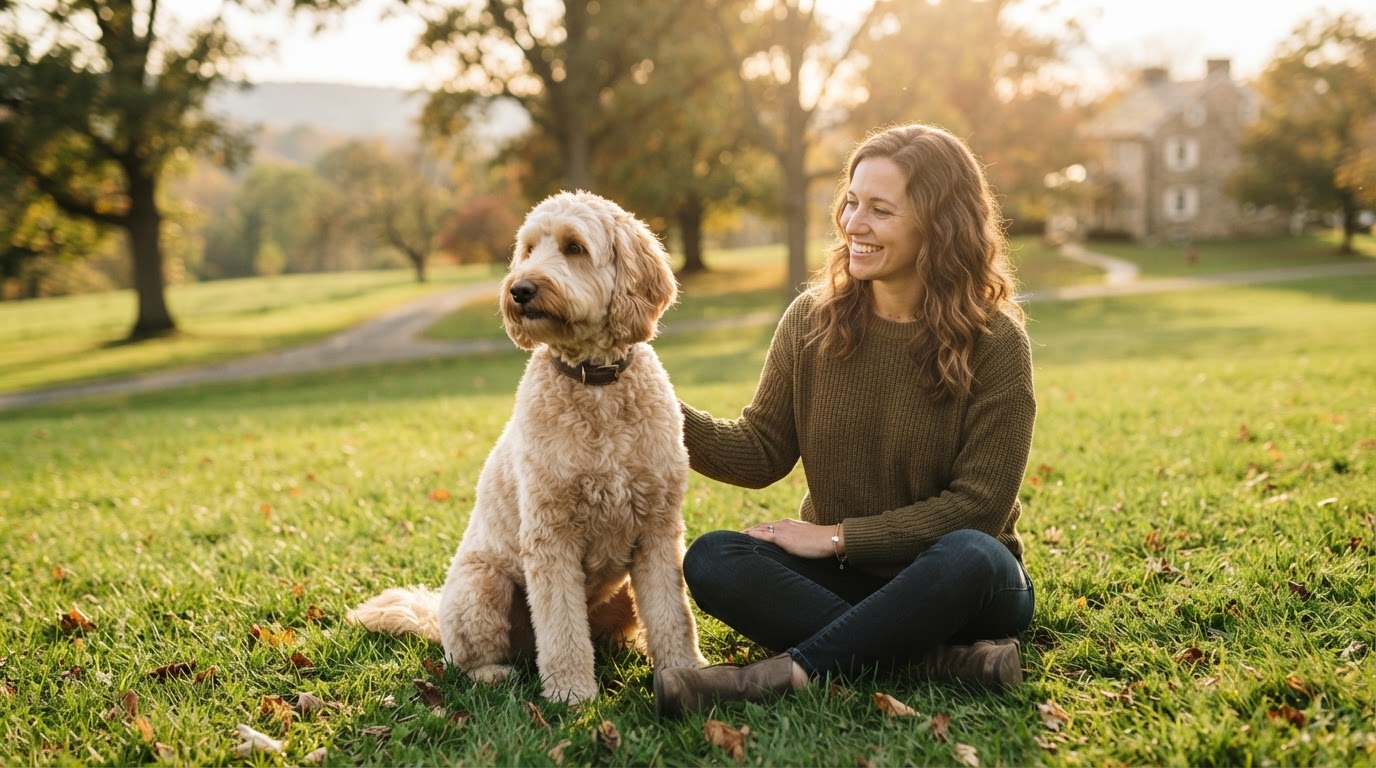
Goldendoodles are widely recognized for their soft, often curly coats and friendly appearance. Many people expect them to combine the affectionate personality of a Golden Retriever with the intelligence and lower-shedding coat associated with a Poodle.
But is a Goldendoodle truly a good companion pet?
A Goldendoodle can become a wonderful companion dog for the right person or family. However, its temperament, size, coat, shedding, health, and care requirements are not guaranteed by the Goldendoodle name.
Responsible matching requires evaluating the individual dog—not relying on assumptions about the mix.
What Is a Goldendoodle?
Golden Retriever
Friendly, devoted, intelligent, and active — a people-oriented sporting dog.
Poodle
Intelligent, active, people-oriented, and highly trainable — in Standard, Miniature, or Toy sizes.
A Goldendoodle is a mixed-breed dog with Golden Retriever and Poodle ancestry.
The Poodle parent may be Standard, Miniature, or occasionally Toy. This means Goldendoodles can vary considerably in:
- Adult size and weight
- Energy level
- Coat type
- Shedding
- Grooming requirements
- Temperament
- Sensitivity
- Confidence
- Health
- Training needs
Goldendoodles are not a standardized breed. There is no single, universally predictable Goldendoodle size, coat, appearance, or personality.
Two Goldendoodles—even siblings from the same litter—may develop very differently.
Can a Goldendoodle Make a Good Companion Pet?
Yes. Many Goldendoodles are affectionate, intelligent, social, and highly engaged with their people.
Potential companion qualities may include:
These qualities reflect traits commonly associated with Golden Retrievers and Poodles, but they cannot be promised in every mixed-breed puppy or adult dog.
A dog's actual temperament, behavior, health, age, energy, and history must guide the placement decision.
Goldendoodle Temperament
Golden Retrievers are commonly described as friendly, devoted, active, and eager to please. Poodles are generally described as intelligent, active, people-oriented, and highly trainable.
A Goldendoodle may inherit many of these characteristics.
It may also inherit:
The result is not always the calm, effortless family pet shown in advertising or social-media photographs.
Some Goldendoodles settle easily. Others require considerable training, exercise, structure, and patience. Individual temperament matters more than generation labels, coat color, or appearance.
How Large Does a Goldendoodle Become?
Goldendoodle size varies because Poodles come in different sizes and Golden Retrievers are medium-to-large dogs.
Terms such as "standard," "medium," "mini," "petite," or "micro" are not always used consistently. A marketing label does not guarantee a specific adult size.
When evaluating a Goldendoodle, ask:
Standard Poodle parent. Largest; closest to Golden Retriever size.
Ranges are general and not guaranteed. A marketing label does not guarantee a specific adult size.
- What are the verified sizes of both parents?
- Is the Poodle ancestry Standard, Miniature, or Toy?
- How large are adult dogs from previous related litters?
- Is the dog already an adult with an established size?
- Can the recipient safely handle the dog's likely weight and strength?
Final size affects leash handling, housing, transportation, grooming, exercise, accessibility, and veterinary costs.
An adult Goldendoodle may be easier to match responsibly because its size, coat, energy, and temperament are already more apparent.
Are Goldendoodles Hypoallergenic?
No dog can be guaranteed to be hypoallergenic.
Some Goldendoodles may shed less than a Golden Retriever. Others may shed considerably. Coat appearance does not determine whether a dog will trigger an allergic reaction.
Dog allergens are found in dander, saliva, and urine—not simply in loose hair. The American Academy of Allergy, Asthma & Immunology states that there are no truly hypoallergenic dog breeds.
Anyone with known or suspected dog allergies should consult a qualified allergist before bringing a dog into the household. Spending time with one Goldendoodle does not guarantee that another Goldendoodle will cause the same response.
Learn more from the American Academy of Allergy, Asthma & Immunology.
Goldendoodle Coat and Grooming Needs
Goldendoodle coats may be straight, wavy, curly, or a combination of textures. Some coats shed. Others hold loose hair within the coat, where it can form mats.
A dog that sheds less is not necessarily easier to maintain.
Many Goldendoodles require:
A soft wave between the two parent coats. Often low-to-moderate shedding; brush several times a week to prevent tangles.
Coat type cannot be predicted from the “Goldendoodle” name — and a lower-shedding coat is not always lower maintenance.
Matting can become uncomfortable and may pull on the skin. Severe mats sometimes require the coat to be clipped very short.
Prospective recipients should consider whether they have the time, physical ability, and budget to maintain the dog's coat throughout its life.
How Much Exercise Does a Goldendoodle Need?
Both Golden Retrievers and Poodles are active dogs with working and retrieving backgrounds. Many Goldendoodles need substantial daily exercise and mental enrichment.
Activities may include:
Exercise needs depend on the dog's age, size, health, conditioning, and temperament.
A yard alone does not satisfy every dog. Many Goldendoodles need active interaction with people in addition to access to outdoor space.
Without appropriate physical and mental outlets, an energetic Goldendoodle may become restless, vocal, destructive, or difficult to manage.
Are Goldendoodles Easy to Train?
Many Goldendoodles are intelligent and responsive to reward-based training. Intelligence, however, does not mean a dog arrives knowing household rules.
An intelligent dog may quickly learn desirable behaviors—and may also quickly learn how to open doors, steal food, demand attention, or avoid activities it dislikes.
Training should include:
Training should be consistent, patient, and suited to the individual dog. Harsh correction can damage trust and may be especially difficult for a sensitive dog.
Goldendoodle Health Considerations
Mixed ancestry does not guarantee better health.
A Goldendoodle may inherit health risks associated with Golden Retrievers, Poodles, or both. Depending on the individual dog and its ancestry, veterinary attention may include:
When considering a puppy from a breeder, request verifiable health-screening information for both parents. A basic veterinary examination is not the same as breed-appropriate genetic and orthopedic screening.
When adopting an adult Goldendoodle, request all available veterinary and behavioral records. Some background may be unknown, so an independent veterinary examination remains important.
No breeder, shelter, rescue, or foundation can guarantee lifelong health.
Learn about the parent breeds through the American Kennel Club's guides to Golden Retrievers and Poodles.
Are Goldendoodles Good With Children?
Some Goldendoodles can be excellent family companions. No dog should be assumed safe or suitable for children based solely on its breed mix.
Compatibility depends on:
- The dog's temperament
- Size and energy
- Training
- Previous experiences
- The children's ages and behavior
- Active adult supervision
- The dog having a quiet place to rest
- Respectful child-dog interaction
A large, excited Goldendoodle may accidentally knock over a small child or a person with balance limitations. A smaller dog may feel overwhelmed by loud or unpredictable handling.
Adults must supervise interactions and remain responsible for the dog's care.
Goldendoodle Generations Do Not Guarantee Results
Goldendoodles may be described using labels such as F1, F1B, F2, or multigenerational. These terms describe ancestry, not guaranteed outcomes.
A generation label cannot promise:
Ask for clear information about the individual dog and its parents rather than relying on letters, percentages, or marketing language.
Questions to Ask Before Choosing a Goldendoodle
Before welcoming a Goldendoodle companion pet, ask:
Just starting
A responsible answer may be yes, no, or not yet.
How Golden Green Foundation Evaluates Goldendoodles
Golden Green Foundation is a registered 501(c)(3) companion-dog charity rooted in Eastern Pennsylvania. We are preparing for an anticipated 2027 program launch serving qualified individuals and families in Lehigh, Northampton, Berks, Bucks, and Montgomery counties as resources become available.
Goldendoodles may be considered as potential Golden Canines, but no breed or mix is automatically accepted.
Our developing process is intended to evaluate:
- Temperament
- Health
- Age and energy
- Size and strength
- Training and behavior
- Grooming requirements
- Household compatibility
- Accessibility
- Recipient expectations
- Ability to provide lifelong care
- The dog's response during a gradual introduction
Applying or being nominated will not guarantee eligibility, selection, or placement. The availability of a Goldendoodle cannot be promised.
The Foundation's goal is to seek a responsible relationship between a suitable person and a suitable dog—not to fulfill a request for a particular appearance or fashionable mix.
The Final Answer: A Goldendoodle Can Be a Good Companion
A Goldendoodle can be a loving, intelligent, active, and deeply connected companion. It can also require substantial grooming, exercise, training, veterinary care, and human interaction.
The Goldendoodle name alone does not determine whether the dog will be a good companion pet.
A successful match depends on whether the individual dog's temperament, health, size, needs, and energy fit the recipient's household, abilities, lifestyle, and expectations.
The right dog matters more than the coat, generation label, or mix.
Read what a companion dog is, learn why temperament matters more than breed, or consider whether you are ready for a companion dog.
This article provides general educational information. It is not veterinary, medical, allergy, disability, housing, breeding, or legal advice.
Golden Green LLC
Your Lawn’s Best Friend — lawn care in Eastern Pennsylvania.
Visit goldengreenlawns.com